

Choosing an affordable LMS for RTOs isn’t simply about finding the lowest monthly subscription. The real cost of an LMS includes far more than the licence fee, it also includes implementation, administration, compliance, staff productivity, and the need for additional software.
A platform with a lower upfront price can become more expensive over time if it requires multiple add-ons, manual processes, or third-party integrations to perform everyday tasks.
Before comparing prices, use these five questions to evaluate every LMS provider. Each question will help you understand the platform’s long-term value, not just its monthly cost.
1. Does the Platform Include the Features You’ll Actually Use?
The cheapest LMS can quickly become the most expensive if essential functionality is sold as paid add-ons or requires separate software.
An effective LMS for RTOs should include the tools your trainers and administrators use every day as part of the standard subscription.
Questions to ask the vendor
- Is AVETMISS software included in the base subscription or sold as an additional module?
- Can Practical Observations be completed on a mobile device?
- Does the platform include a central Marking Dashboard?
- Can it support both trainer-led delivery and Self-Served Courses?
- Are AI-assisted content creation tools included?
- Are future platform updates included in the subscription?
What a good answer looks like
Look for a platform that includes core workflows, assessment management, reporting, compliance tools, AI capabilities, and student management—without requiring additional purchases.
Red flags
- Compliance features are sold separately.
- Assessment tools require third-party software.
- AI capabilities are only available on premium plans.
- Important workflows are split across multiple systems.
How Nimbu approaches this
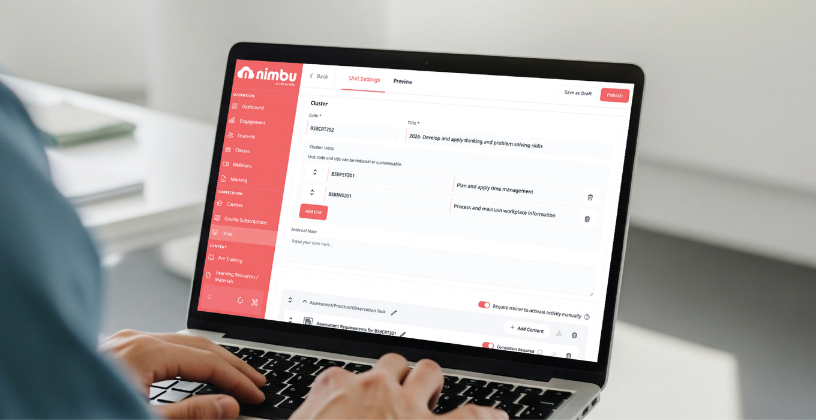
Nimbu includes Learning Journey, Marking Dashboard, Learning Progress Summary, Practical Observations, Self-Served Courses, Microsites, AVETMISS export, Michi AI Assistant, and Michi Tutor Assistant as standard, helping RTOs avoid paying extra for essential functionality.
2. Will It Reduce Administration Over Time?
The value of an LMS isn’t measured only by its price, it’s also measured by how much time it saves.
A quality training management software platform should automate repetitive processes, reduce duplicate data entry, and simplify everyday workflows so trainers can spend more time supporting students.
Questions to ask the vendor
- Which administrative tasks are automated?
- How are assessments managed from start to finish?
- Can trainers monitor student progress from one dashboard?
- Does the system reduce duplicate data entry?
- Can administrators generate reports without exporting data into spreadsheets?
What a good answer looks like
A strong platform should streamline assessment management, reporting, communication, and student progress tracking from one integrated system.
Red flags
- Staff still rely on spreadsheets.
- Multiple systems are needed to complete routine tasks.
- Reporting requires manual data preparation.
- Student progress is difficult to monitor.
How Nimbu approaches this
Nimbu combines Learning Journey, Learning Progress Summary, Marking Dashboard, Practical Observations, and integrated reporting to simplify daily administration and help trainers focus on delivering quality training.
3. Can It Support Future Growth?

An LMS should continue delivering value as your organisation grows—not require additional systems or complex workarounds.
An LMS for RTOs in Australia should make it easy to add qualifications, increase student numbers, and expand delivery without creating unnecessary administration.
Questions to ask the vendor
- How are new qualifications added?
- Can the platform support multiple campuses or delivery locations?
- Does pricing scale predictably?
- Are AI-assisted content creation tools included as your content library grows?
- How does the system support increasing student numbers?
What a good answer looks like
Look for platforms that include scalable workflows, AI-powered productivity tools, and flexible course management without requiring major changes as your organisation expands.
Red flags
- Growth requires additional software modules.
- Content creation remains entirely manual.
- Administration increases significantly as student numbers grow.
- Pricing becomes unpredictable as your organisation expands.
How Nimbu approaches this
Nimbu supports growth through Unit Versioning, Cluster Units, Self-Served Courses, mobile-friendly Microsites, and Michi AI Assistant, which helps Content Editors create assessments, quizzes, learning materials, Pre-Training Reviews, and other course resources more efficiently as content requirements increase. Michi Tutor Assistant also provides students with AI-powered support, helping organisations scale student assistance without increasing routine enquiries to trainers.
4. Does It Simplify Compliance?
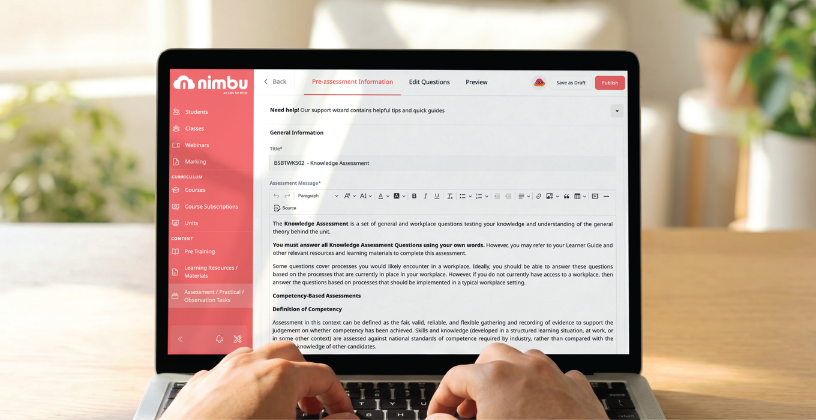
Compliance should be built into everyday workflows rather than managed through separate systems and manual processes.
Integrated AVETMISS software capabilities help reduce reporting effort while improving confidence in the accuracy of student records.
Questions to ask the vendor
- How is AVETMISS reporting managed?
- Where is assessment evidence stored?
- How are student records maintained?
- Can reports be generated directly from the LMS?
- How are qualification updates managed?
What a good answer looks like
Choose a platform that embeds compliance into day-to-day operations, making reporting and record management part of normal workflows rather than additional administrative tasks.
Red flags
- Separate reporting software is required.
- Assessment evidence is stored in multiple locations.
- Compliance relies on spreadsheets.
- Reporting requires extensive manual preparation.
How Nimbu approaches this
Nimbu combines structured assessment workflows, organised student records, Unit Versioning, Pre-Training Reviews, Pre-Course Materials, and integrated AVETMISS export to simplify compliance while reducing administrative effort.
5. Will the Provider Continue Supporting Your RTO?
The value of an LMS extends well beyond implementation.
Choosing an affordable LMS for RTOs also means choosing a provider that continues helping your organisation improve long after the platform goes live.
Questions to ask the vendor
- Is onboarding included?
- How quickly does the support team respond?
- How often are product updates released?
- Is customer feedback used to guide product improvements?
- Are product demonstrations, training resources, and ongoing guidance available?
What a good answer looks like
A strong provider offers responsive customer support, continuous platform improvements, practical guidance, and ongoing product education that helps customers get more value from the system over time.
Red flags
- Support ends after implementation.
- Updates are infrequent.
- Training resources are limited.
- Additional charges apply for basic customer support.
How Nimbu approaches this
Nimbu provides guided onboarding, Knowledge Base resources, product demonstrations, practical workflow guidance, ongoing feature updates, and customer support tailored specifically to Australian RTOs, helping organisations continue improving long after implementation.

Compare Value Before You Compare Price
The most affordable LMS for RTOs isn’t necessarily the platform with the lowest monthly subscription. It’s the one that reduces administration, supports compliance, improves productivity, and continues delivering value as your organisation grows.
Using these five questions during every vendor demonstration gives you a practical framework for comparing LMS providers consistently. Rather than focusing only on price, you’ll be able to evaluate the factors that have the greatest impact on your organisation’s long-term success.
Pricing starts from $850 per month and includes up to 500 student seats, giving Australian RTOs access to a purpose-built LMS with practical workflows, integrated compliance tools, AI-powered productivity features, and ongoing customer support. You can also use the Monthly Cost Calculator to estimate your subscription before speaking with the team.