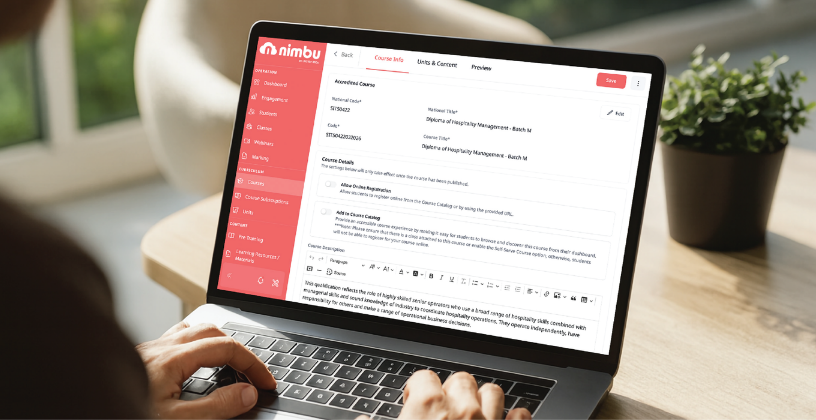

As organisations grow, training becomes more complex. New employees need structured onboarding, teams require ongoing professional development, compliance obligations increase, and administrators need visibility across multiple departments or locations. Managing these processes with spreadsheets, shared folders, and disconnected systems often results in inconsistent training, duplicated work, and unnecessary administration.
Enterprise learning management helps growing organisations simplify training and compliance by centralising learning, automating administration, supporting continuous workforce development, improving compliance visibility, enabling scalable training delivery, and using AI to reduce repetitive work.
Rather than relying on multiple systems, organisations can manage onboarding, mandatory training, assessments, reporting, and professional development from one platform. Solutions like Nimbu combine practical learning workflows with automation features such as Learning Journey, Learning Progress Summary, Practical Observations, Self-Marking Quizzes, Microsites, and AI-powered assistants to help organisations deliver structured learning while reducing administrative workload.
Whether you’re an RTO delivering accredited training or a business managing workforce development, the right platform supports long-term growth by making training more consistent, engaging, and easier to manage.
Traditional Training vs Enterprise Learning Management
| Traditional Training | Enterprise Learning Management |
| Multiple spreadsheets and shared folders | One central platform for managing all training |
| Manual onboarding processes | Structured Learning Journeys for every role |
| Paper-based or disconnected records | Centralised digital training records |
| Manual compliance tracking | Automated reporting and real-time progress tracking |
| Different learning experiences across teams | Consistent training across departments and locations |
| Time-consuming administration | Automated workflows that reduce repetitive tasks |
Growing organisations need more than an online course library, they need a platform that simplifies training while supporting compliance and business growth. Here are six ways enterprise learning management helps organisations achieve exactly that.
1. A Corporate Learning Management System Centralises Every Stage of Training
As organisations expand, training often becomes scattered across multiple systems. Onboarding documents may live in shared folders, compliance records in spreadsheets, and learning resources across different applications. This fragmentation makes it difficult to maintain consistency or monitor progress.
A modern corporate learning management system centralises every stage of training into one platform. From onboarding and mandatory training to professional development and assessments, administrators can manage everything through a single dashboard.
For organisations using Nimbu, this includes practical features such as:
- Learning Journey to guide students and employees through structured training pathways.
- Learning Progress Summary to monitor completion and identify students who need additional support.
- Self-Marking Quizzes that provide instant feedback while reducing manual marking.
- Practical Observations for recording workplace-based competency assessments.
- Microsites, giving students and employees a branded, responsive portal where they can access learning anytime, from any device.
Instead of switching between multiple systems, Trainers and administrators gain complete visibility over training progress while ensuring every participant receives a consistent learning experience.

2. Learning Management Software Automates Everyday Administration
As organisations grow, administrative workload often grows faster than the workforce itself. Enrolling participants, tracking progress, communicating with students, recording assessments, and producing reports can quickly consume valuable time.
Modern learning management software reduces this burden by automating many routine tasks that previously required manual effort.
Rather than spending hours updating spreadsheets or chasing incomplete training, administrators can automate:
- Student enrolments
- Learning notifications
- Assessment tracking
- Learning Progress Summary
- Course completion monitoring
- Reporting
- Practical Observation records
These automations improve operational efficiency while reducing the risk of human error.
For RTOs, Nimbu also streamlines everyday training management through features like Learning Journey, Self-Marking Quizzes, Practical Observations, and integrated reporting, allowing Trainers to spend more time supporting students instead of completing repetitive administration.
Automation doesn’t replace people, it gives them more time to focus on activities that create real value.
3. An Employee Training Platform Supports Continuous Workforce Development
Training shouldn’t end after onboarding.
Growing organisations need employees to continually develop new skills, stay up to date with changing regulations, and build capability as business needs evolve.
An effective employee training platform makes continuous learning part of everyday operations by delivering:
- New employee onboarding
- Compliance refreshers
- Role-specific training
- Leadership development
- Skills enhancement programs
- Professional development pathways
Because learning is delivered through one central platform, employees can complete training at their own pace while managers monitor progress across departments.
Nimbu further supports continuous learning through Microsites, giving employees and students access to learning materials, assessments, quizzes, videos, PDFs, Articles, Podcasts, Canva resources, and SCORM content from virtually anywhere. Combined with learning journey, organisations can deliver structured learning experiences that remain consistent regardless of team size or location.
Providing continuous learning opportunities not only improves workforce capability but also helps organisations adapt more quickly to changing industry requirements.

4. Compliance Training Software Helps Organisations Stay Audit-Ready
As organisations grow, keeping training records accurate and up to date becomes increasingly important. Whether you’re operating in vocational education, healthcare, hospitality, manufacturing, financial services, or another regulated industry, demonstrating compliance is far easier when training data is managed from one central platform.
Reliable compliance training software helps organisations:
- Track mandatory training and certifications
- Monitor assessment outcomes
- Identify overdue training
- Maintain accurate digital records
- Generate reports when required
- Demonstrate compliance during audits
Instead of relying on manual spreadsheets or disconnected systems, administrators gain real-time visibility into training activity, making it easier to identify gaps before they become compliance risks.
For RTOs, Nimbu simplifies compliance management through integrated features such as Practical Observations, Learning Progress Summary, and AVETMISS Export, helping training teams manage evidence, monitor progress, and produce the records required for reporting.
When compliance is built into everyday workflows, organisations spend less time preparing for audits and more time supporting quality learning outcomes.
5. A Workforce Learning Platform Supports Sustainable Business Growth
Growth creates opportunities, but it also increases the complexity of delivering consistent training.
New employees need structured onboarding, existing teams require ongoing development, and organisations must ensure everyone receives the same high-quality learning experience regardless of location.
A scalable workforce learning platform helps organisations manage this growth without increasing administrative workload.
As your organisation expands, a modern platform should make it easy to:
- Deliver role-specific learning pathways
- Standardise onboarding across departments
- Support hybrid and remote teams
- Track progress across multiple locations
- Update learning content from one central platform
Nimbu supports scalable training through learning journey, allowing organisations to create structured learning pathways for different roles or qualifications. Combined with Microsites, employees and students can securely access training materials, assessments, videos, quizzes, SCORM packages, PDFs, Podcasts, Articles, and Canva resources from virtually any device.
Because every participant follows the same structured learning experience, organisations maintain consistency as they grow while reducing the time required to manage training across multiple teams. Growth should create new opportunities, not additional administrative complexity.

6. AI Helps Organisations Scale Training Without Increasing Administration
Creating and maintaining high-quality learning content becomes increasingly challenging as organisations expand. Modern AI tools help training teams work more efficiently by reducing repetitive content development while maintaining educator oversight. Nimbu includes two AI-powered assistants designed for different users.
Michi AI Assistant
Michi AI Assistant supports Content Editors by generating first drafts of:
- Assessments
- Practical Observations
- Quizzes
- Articles
- Learning materials
- Pre-Training Reviews
Using existing training content, Michi helps accelerate course development while allowing subject matter experts to review, edit, and customise the final output.
Michi Tutor Assistant
For students, Michi Tutor Assistant provides personalised learning support directly within the Microsite.
Based on the unit a student is currently studying, it can generate:
- AI-powered content summaries
- Flashcards
- Practice quizzes
These resources help students revise key concepts independently, reinforce learning between training sessions, and prepare more confidently for assessments.
Rather than replacing Trainers or Content Editors, these AI assistants improve productivity, support student engagement, and free training teams to focus on coaching, mentoring, and delivering quality education.
Enterprise Learning Management Helps Organisations Grow With Confidence
Growing organisations need more than a platform for delivering online courses, they need a solution that keeps training organised, supports compliance, reduces administration, and scales alongside the business.
Enterprise learning management provides that foundation by bringing onboarding, professional development, compliance, reporting, and workforce training together in one central platform.
Nimbu combines practical features such as Learning Journey, Learning Progress Summary, Self-Marking Quizzes, Practical Observations, Microsites, AVETMISS Export (for RTOs), and AI-powered tools like Michi AI Assistant and Michi Tutor Assistant to help organisations deliver structured, engaging, and scalable learning experiences.
Whether you’re an Australian RTO delivering accredited training or a growing organisation investing in workforce development, the right platform helps reduce administrative workload while creating a stronger learning culture that supports long-term success.