

Every new student creates more work. Assessments need marking. Practical Observations need recording. AVETMISS data needs maintaining. student communication needs managing. Trainers need visibility over student progress. Administrators need confidence that compliance requirements are being met.
Many RTOs respond by hiring more administrative staff. While this can relieve short-term pressure, it rarely addresses the real problem. The issue is often fragmented workflows rather than a lack of people.
Nimbu helps solve this challenge by centralising assessment marking, Practical Observations, student communication, enrolments, class management, and AVETMISS reporting within a single learning management system. Instead of adding more administrative resources as enrolments grow, RTOs can streamline the workflows that create the workload in the first place.
If your goal is to grow student numbers without growing administrative complexity, the right training delivery software for RTOs can make all the difference.
In this article
- Why Training Delivery for RTOs Becomes Hard to Scale
- How LMS Simplifies the Five Biggest Admin Bottlenecks
- How Nimbu's Learning Management Platform Centralises Training Delivery
- How a Cloud Based LMS Reduces Admin Per Student
- How Learning Management Online Systems Improve Student Experience
- Why a Vocational Training LMS Creates a More Scalable RTO
- Why More RTOs Are Choosing Online Training Delivery Platforms
- Explore a Learning Management System Built for Australian RTOs
- FAQs
Why Training Delivery for RTOs Becomes Hard to Scale
As an RTO grows, training delivery becomes more complex. More students mean more assessments, more observations, more communication, and more compliance requirements.
Without purpose-built LMS for RTOs, these activities often become spread across spreadsheets, email threads, shared drives, paper forms, and multiple systems.
This creates several common problems:
- Trainers spend more time managing paperwork than supporting students
- Assessment turnaround times become slower
- Communication becomes inconsistent
- Compliance evidence becomes harder to locate
- Reporting processes become increasingly manual
- Administrative workload grows faster than enrolments
Many RTOs discover that adding staff simply adds more people to manage inefficient processes.
A more sustainable approach is to simplify the workflows behind training delivery.
How LMS Simplifies the Five Biggest Admin Bottlenecks
A modern learning management system should remove friction from the activities that consume the most administrative time.
For most RTOs, these bottlenecks fall into five key areas.
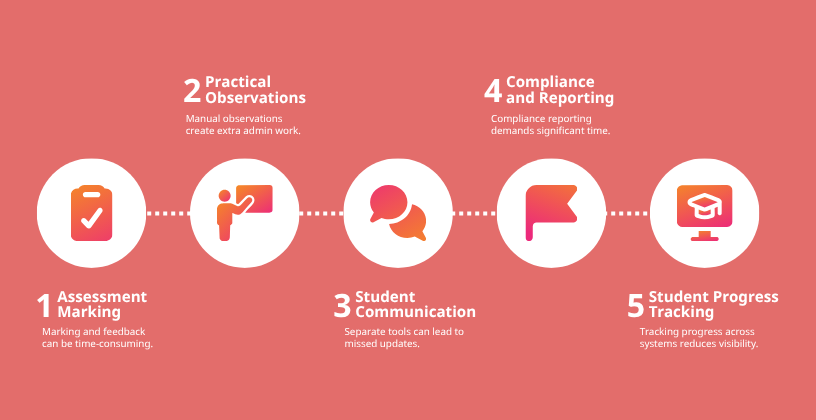
Assessment Marking
Assessment marking is often one of the largest administrative burdens for trainers.
Managing submissions, resubmissions, feedback, and progress tracking across multiple systems creates unnecessary delays and additional workload.
Practical Observations
Practical observations generate a significant amount of evidence that needs to be captured, stored, and linked to student records.
When observation records are handled manually, administration increases dramatically.
Student Communication
students expect timely updates throughout their course.
Managing communication separately from training delivery often creates duplication and visibility issues.
Compliance and Reporting
Compliance obligations continue to grow as student numbers increase.
Without structured processes, reporting can become one of the most time-consuming activities within an RTO.
Student Progress Tracking
Tracking student progression manually requires trainers and administrators to spend valuable time gathering information from multiple sources.
The right learning management platform should simplify all five of these workflows within a single environment.
How Nimbu’s Learning Management Platform Centralises Training Delivery
Unlike generic LMS platforms, Nimbu is built specifically around Australian vocational education workflows.
This learning management platform centralises the activities that typically create administrative pressure for RTOs.
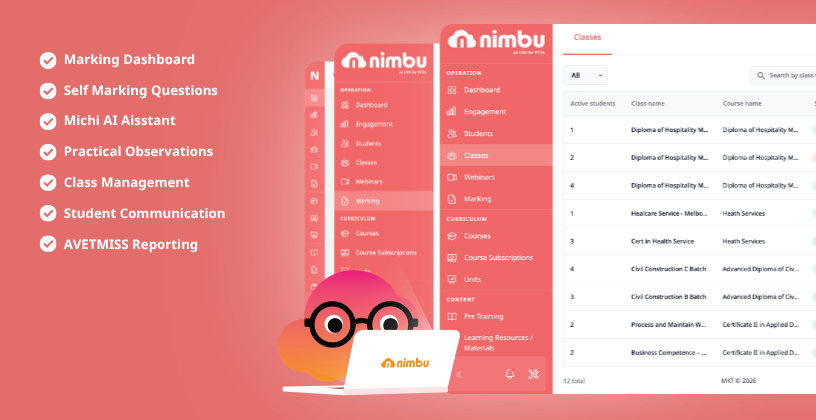
Marking Dashboard
Nimbu’s Marking Dashboard gives trainers a single queue for managing assessments.
Every submission, resubmission, and feedback request is visible in one location.
Instead of searching through emails or folders, trainers can immediately identify what requires attention.
This creates faster turnaround times and significantly reduces administrative effort.
Self-Marking Questions
Not every assessment question requires manual marking.
Nimbu’s Self-Marking Questions automatically assess eligible responses and direct trainer attention towards activities that require professional judgement.
This helps reduce repetitive marking tasks while maintaining quality outcomes.
Michi AI Assistant
Nimbu’s Michi AI Assistant helps trainers create and manage training content more efficiently. Instead of spending hours building assessments, drafting learning materials, or generating questions from scratch, trainers can use Michi to accelerate content creation while maintaining quality and consistency.
By reducing the time spent on repetitive content development tasks, Michi allows trainers to focus more on student support, assessment quality, and training delivery. For growing RTOs, this creates additional operational efficiencies without increasing administrative workload.
Practical Observations
Nimbu allows trainers to record Practical Observations directly within the platform.
Observations can be captured at the point of work, linked to student records, timestamped, and retained as part of the evidence trail.
This creates a more efficient process while supporting compliance requirements.
Class Management
Nimbu’s Class Management tools help trainers manage schedules, students, attendance, and delivery activities from a central location.
Instead of relying on multiple tracking systems, trainers gain a clearer view of training delivery across their cohorts.
Student Communication
Communication sits alongside student activity rather than in separate systems.
This improves visibility and helps trainers maintain more consistent student engagement.
AVETMISS Reporting
Nimbu supports AVETMISS reporting workflows, helping RTOs manage reporting obligations more efficiently and with greater confidence.
How a Cloud Based LMS Reduces Admin Per Student
A cloud-based LMS creates efficiencies that become increasingly valuable as enrolments grow.
Rather than adding administrative workload every time new students are enrolled, the system helps automate and centralise repetitive tasks.
With Nimbu, RTOs can reduce administration through:
- Centralised student records
- Automated assessment workflows
- Self-Marking Questions
- Digital Practical Observations
- Integrated communication
- Real-time student progress tracking
- Streamlined reporting processes
This helps reduce the amount of administrative effort required for each student.
As a result, RTOs can scale delivery more effectively without proportionally increasing staffing requirements.
The best RTO LMS solutions are not simply content delivery systems. They are operational platforms that improve efficiency across the entire student journey.
How Learning Management Online Systems Improve Student Experience
Modern learning management online systems improve far more than operational efficiency.
They also create better student experiences.
When training delivery processes are fragmented, students often encounter:
- Delayed feedback
- Limited visibility over progress
- Difficulty accessing resources
- Inconsistent communication
- Longer assessment turnaround times
A well-designed Online Learning Management System helps eliminate these frustrations.
students can access resources, submit assessments, track progress, review feedback, and communicate with trainers through a single platform.
The importance of feedback becomes particularly evident here.
When trainers spend less time managing administration, they can spend more time providing meaningful student support and feedback.
This creates a stronger learning experience while improving student satisfaction and engagement.
Why a Vocational Training LMS Creates a More Scalable RTO
A purpose-built vocational training LMS helps RTOs create repeatable systems that continue working as enrolments increase.
Instead of relying on manual coordination between multiple systems, training delivery becomes more structured and easier to manage.
A scalable vocational training LMS should help RTOs:
- Manage assessments more efficiently
- Record observations digitally
- Improve trainer productivity
- Simplify compliance processes
- Reduce duplicated administration
- Improve student visibility
- Support organisational growth
These benefits become increasingly important as student numbers rise.
The goal is not simply to digitise existing processes.
The goal is to create workflows that continue performing effectively as the organisation grows.
Why More RTOs Are Choosing Online Training Delivery Platforms
Many providers eventually reach a point where administration becomes the biggest barrier to growth.
This is why more organisations are investing in online platforms that combine assessment management, student engagement, compliance workflows, communication, and reporting within one platform.
Rather than increasing administrative headcount every time enrolments grow, RTOs can improve the systems that support delivery.
For many organisations, this results in:
- Faster training delivery processes
- Better visibility across student activity
- Reduced administration per student
- More consistent compliance workflows
- Improved trainer productivity
- Better student experiences
A modern Australian VET LMS helps create the operational foundation needed to support sustainable growth.
Explore a Learning Management System Built for Australian RTOs
Nimbu is designed specifically for Australian vocational education providers.
By combining Class Management, Marking Dashboards, Self-Marking Questions, Practical Observations, student communication, progress tracking, and AVETMISS reporting within a single platform, Nimbu helps RTOs simplify training delivery and reduce administrative complexity.
Instead of hiring more staff to manage fragmented workflows, RTOs can create more efficient systems that support growth.
Whether you’re looking to improve student experience, streamline compliance processes, or scale operations more effectively, Nimbu provides the structure needed to support long-term success.
Book a demo or start your free trial today and discover how Nimbu can help your RTO scale training delivery without hiring more admin.
FAQs
Yes, an RTO LMS can reduce the need for additional administrative staff as enrolments grow. By centralising assessment marking, Practical Observations, student communication, AVETMISS reporting, and progress tracking in one platform, RTOs eliminate many repetitive manual tasks. This allows teams to support more students without increasing administrative headcount at the same rate.
In many cases, improving systems delivers greater long-term benefits than adding more administrative resources. Training delivery software helps standardise workflows, reduce duplication, and improve visibility across operations, creating efficiencies that continue as student numbers grow.
An RTO should consider investing in an RTO LMS when administrative workload begins growing faster than enrolments. Common signs include delayed assessment marking, fragmented communication, reporting bottlenecks, and increasing compliance pressure.
Yes, platforms such as Nimbu allow RTOs to manage assessment marking, Practical Observations, student communication, progress tracking, and AVETMISS reporting within a single system. This reduces the need to move information between multiple tools and improves operational visibility.
Nimbu helps RTOs scale training delivery by centralising Class Management, assessment workflows, Practical Observations, communication, and reporting. Features such as the Marking Dashboard and Self-Marking Questions reduce repetitive administration, allowing teams to support more students without proportionally increasing resources.