

Choosing the best LMS for RTOs isn’t about finding the platform with the longest list of features. It’s about selecting a solution that simplifies compliance, reduces administration, and creates a better learning experience for both trainers and students.
As businesses in Australia prepare for the updated Standards for RTOs and growing student expectations, many are replacing generic platforms with software designed specifically for vocational education.
The three features that matter most are:
- Compliance-first workflows that simplify ASQA and AVETMISS requirements.
- Automation that reduces repetitive administration and improves operational efficiency.
- Integrated AI and student engagement tools that support both content creation and student success.
A learning management system for RTOs should help your organisation work smarter today while supporting sustainable growth tomorrow. Here’s what to look for when comparing platforms.
- 1. A Learning Management System for RTOs Should Simplify Compliance, Not Complicate It
- 2. A Strong RTO Management System Should Reduce Administration
- 3. The Best RTO LMS Should Support Both Trainers and Students
- Generic LMS vs Purpose-Built RTO LMS
- Choosing Software That Grows with Your RTO
- Make a Smarter LMS Decision
- Ready to See Nimbu in Action?
- Frequently Asked Questions
- What should Australian RTOs look for when choosing the best LMS?
- Why is a purpose-built LMS better than a generic platform?
- How can an LMS reduce administrative workload?
- How do Michi AI Assistant and Michi Tutor Assistant support RTOs?
- Can Nimbu support classroom, workplace, and online training?
- How does Nimbu help RTOs prepare for compliance and reporting?
1. A Learning Management System for RTOs Should Simplify Compliance, Not Complicate It
Compliance is at the heart of every Australian RTO. From assessment records and student progress to evidence collection and reporting, maintaining accurate documentation is essential for meeting regulatory obligations.
With the revised Standards for RTOs (2025) placing greater emphasis on quality outcomes, student support, and evidence-based compliance, relying on spreadsheets and disconnected systems is becoming increasingly difficult.
The best LMS for RTOs should make compliance part of everyday operations rather than an additional administrative task. Instead of managing information across multiple platforms, trainers and administrators should be able to access assessment records, student evidence, communication history, and reporting tools from a single environment.
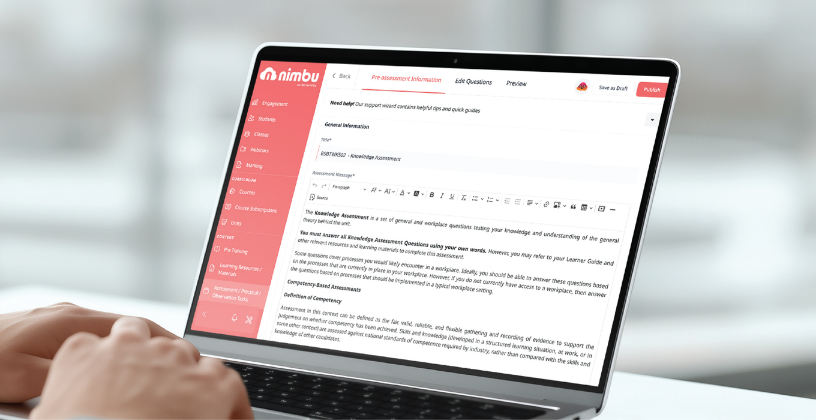
Look for Built-in Compliance Workflows
Purpose-built RTO software should include features that support compliance from enrolment through to completion, including:
- AVETMISS reporting
- Pre-Training Reviews (PTRs)
- Pre-Course Material (PCM)
- Structured Learning Journeys
- Online assessments
- Practical Observations
- Centralised student records
- Assessment version control
- Audit-ready evidence storage
When these workflows are integrated into your LMS, compliance becomes part of the training process instead of something completed afterwards.
An AVETMISS Submission Workflow Should Save Time
Preparing AVETMISS submissions shouldn’t involve exporting spreadsheets, manually validating data, and correcting errors across multiple systems. An effective LMS automates much of this process by collecting structured student data throughout the student journey.
With Nimbu’s AVETMISS reporting tools, training providers can generate exports more efficiently while maintaining consistent student records and reducing manual data handling.
Many RTOs using purpose-built systems report significant time savings during reporting periods, with some organisations reducing administration by [30–40%] after moving compliance and reporting workflows into a single platform.*
Compliance Should Support Better Training, Not Create More Administration
The right LMS doesn’t just help you prepare for audits. It gives trainers and administrators confidence that compliance activities are happening naturally as part of everyday delivery.
Instead of chasing paperwork, searching through emails, or maintaining multiple spreadsheets, your team can focus on supporting students and delivering high-quality vocational education.
2. A Strong RTO Management System Should Reduce Administration
For many training providers, administration—not training—is what consumes the most time. Managing assessments, responding to student enquiries, tracking progress, collecting workplace evidence, and updating student records can quickly become overwhelming as enrolments grow.
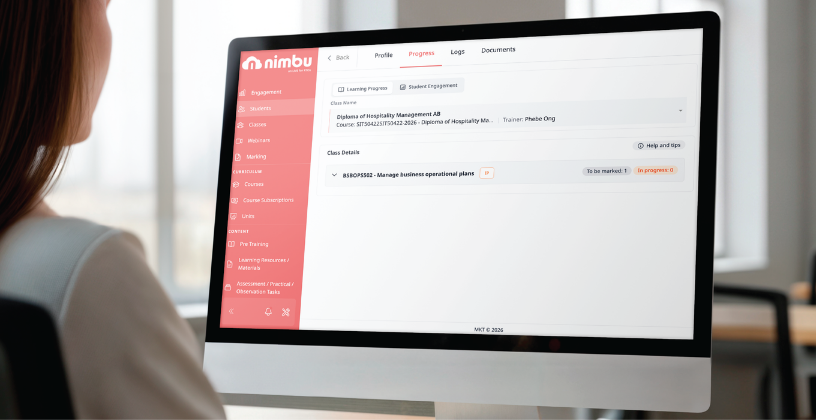
A modern RTO management system should reduce this workload by automating repetitive tasks and centralising day-to-day operations. Rather than switching between multiple systems, trainers should be able to manage assessment marking, student progression, observations, and communication from a single platform.
Nimbu supports this through features including:
- Marking Dashboard
- Learning Progress Summary
- Practical Observations
- Self-Served Courses
- Learning Journey
- Student Management
- Integrated communication tools such as direct trainer to student feedback
These workflows help reduce duplicate data entry, improve visibility across the student journey, and create a more efficient experience for both trainers and administrators.
Many RTOs implementing purpose-built systems have reported administrative time savings of almost 50% and significantly faster assessment turnaround times after replacing manual processes with integrated workflows.
As student numbers increase, these efficiencies become even more valuable, allowing organisations to scale without increasing administrative complexity at the same pace.
3. The Best RTO LMS Should Support Both Trainers and Students
The best RTO LMS does more than deliver learning materials. It creates a connected experience that helps trainers work more efficiently while giving students the support they need to succeed.
For trainers and content teams, that means reducing the time spent creating learning resources, assessments, and course content. For students, it means having access to learning materials, feedback, and support whenever and wherever they need it.
A modern LMS should support every stage of the learning journey, not just course delivery.
AI That Supports Course Development
Creating high-quality training materials is one of the most time-consuming responsibilities for content editors.
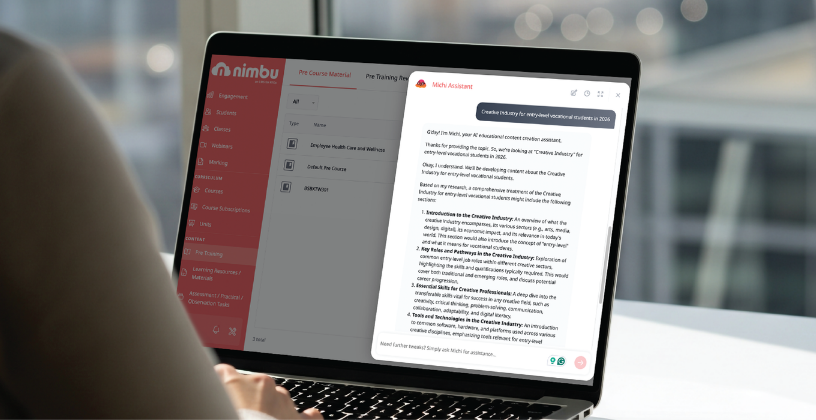
Nimbu’s Michi AI Assistant helps content editors accelerate course development by generating:
- Assessments
- Quizzes
- Learning materials
- Training articles
- Pre-Training Reviews (PTRs)
- Practical Observation templates
Content editors can also:
- Brainstorm ideas for new learning resources
- Create content from simple prompts
- Import existing documents or website URLs
- Apply AI-generated content directly into course workflows
Instead of spending hours creating resources from scratch, content teams can focus on refining and improving course quality while Michi handles repetitive content creation.
24/7 Student Support with Michi Tutor Assistant
Learning doesn’t stop when trainers finish for the day.
Many students study after work, during breaks, while travelling, or before workplace assessments. Questions often arise outside normal business hours, and waiting for a response can interrupt learning momentum.
Michi Tutor Assistant provides students with instant, AI-powered support directly within the LMS.
Students can:
- Ask course-specific questions
- Receive explanations of difficult concepts
- Revise learning materials
- Prepare for assessments
- Continue learning independently
Because support is available whenever students need it, students stay engaged while trainers spend less time answering routine questions.

Built-in Learning Tools That Improve Engagement
Student engagement depends on more than simply making content available.
Nimbu includes interactive learning tools that help students reinforce knowledge throughout their course, including:
- Flashcards for quick revision
- Practice Quizzes to build confidence before assessments
- Self-Marking Quizzes for immediate feedback
- Learning Journey to guide students through each stage of their qualification
- Mobile-friendly Microsites for learning across phones, tablets, and desktops
Combined with structured assessments and flexible delivery options, these tools help students stay engaged and progress through their training with greater confidence. By bringing AI, learning resources, and student support together in one platform, Nimbu creates a better experience for both educators and students.
Generic LMS vs Purpose-Built RTO LMS
When comparing platforms, it’s important to look beyond feature lists and consider how well the system supports the day-to-day realities of vocational education.
| Capability | Generic LMS | Nimbu – Purpose-Built for Australian RTOs |
| Compliance workflows | Often rely on manual processes or external tools | Integrated workflows supporting compliance throughout the student journey |
| AVETMISS reporting | Manual exports and additional validation | Built-in AVETMISS reporting with streamlined export workflows |
| Assessment management | Basic assessment functionality | Structured assessment management with Marking Dashboard and Practical Observations |
| Student management | Often requires separate systems | Centralised student management, student progress, communication, and reporting |
| AI capabilities | Limited or external integrations | Michi AI Assistant for content creation and Michi Tutor Assistant for student support |
| Mobile learning | Mobile compatibility varies | Mobile-friendly Microsites designed for flexible learning anywhere |
| Scalability | Additional tools often required as organisations grow | Designed to support growing Australian RTOs from one integrated platform |
The difference isn’t simply the number of features available. It’s how those features work together to simplify compliance, reduce administration, improve student engagement, and support long-term growth.
Choosing Software That Grows with Your RTO
Replacing an LMS is a significant investment, so it’s important to choose a platform that can continue supporting your organisation as it grows.
Whether you’re introducing new qualifications, increasing student numbers, or expanding your delivery model, your LMS should scale without creating additional administrative complexity.
Nimbu combines compliance workflows, student management, assessment management, reporting, AI-powered content creation, and student support within one integrated platform. Instead of relying on multiple disconnected systems, Australian RTOs can manage the entire student journey from enrolment through to completion in a single environment.
Pricing also remains transparent as your organisation grows. Nimbu plans start from $850 per month and include up to 500 student seats, making it easier to budget without unexpected feature upgrades or hidden costs. For organisations with different enrolment numbers, the Monthly Cost Calculator provides an estimated subscription cost before speaking with the sales team.
The right technology shouldn’t create more work as your RTO grows, it should help your team deliver better training, improve operational efficiency, and confidently meet the changing needs of vocational education.
Make a Smarter LMS Decision
Choosing the best LMS for RTOs isn’t about finding the platform with the longest feature list. It’s about investing in technology that simplifies compliance, reduces administration, supports trainers, and creates better learning experiences for students.
As Australia’s vocational education sector continues to evolve, RTOs need more than a generic learning platform. They need a solution built around the realities of vocational education, one that supports assessment management, AVETMISS reporting, student engagement, mobile learning, and the operational workflows that keep an RTO running efficiently.
Nimbu brings these capabilities together in a single training management system, helping Australian RTOs replace disconnected processes with streamlined workflows designed specifically for vocational education.
Whether your organisation is preparing for the updated Standards for RTOs, expanding student enrolments, or looking to improve operational efficiency, choosing the right LMS today can help position your organisation for long-term success.
Ready to See Nimbu in Action?
Experience how Nimbu helps Australian RTOs simplify compliance, reduce administration, improve student engagement, and support flexible training delivery—all from one purpose-built platform.
Pricing starts from $850 per month and includes up to 500 student seats, giving growing RTOs access to a comprehensive LMS without paying extra for essential features. If your enrolment numbers vary, Nimbu’s Monthly Cost Calculator can help estimate your subscription before you speak with the team.
Start your free 30-day trial to explore Nimbu at your own pace, or book a personalised 20-minute demo to see how the platform can support your organisation’s specific training and compliance requirements.
Frequently Asked Questions
What should Australian RTOs look for when choosing the best LMS?
Look for a platform that simplifies compliance, supports the updated Standards for RTOs, reduces administration, improves student engagement, and provides built-in tools for assessment management, reporting, and student support. A purpose-built learning management system for RTOs should support your organisation as it grows.
Why is a purpose-built LMS better than a generic platform?
Generic LMS platforms are designed for broad education or corporate training environments. A purpose-built RTO LMS includes features specifically designed for vocational education, such as AVETMISS reporting, Practical Observations, Learning Journeys, compliance workflows, and integrated student management.
How can an LMS reduce administrative workload?
A modern LMS reduces administration by centralising assessment marking, student records, communication, reporting, and evidence collection within one platform. Features such as the Marking Dashboard, Learning Progress Summary, and automated workflows help trainers and administrators spend less time on repetitive tasks and more time supporting students.
How do Michi AI Assistant and Michi Tutor Assistant support RTOs?
Michi AI Assistant helps content editors create assessments, quizzes, learning materials, articles, and Pre-Training Reviews (PTRs) more efficiently. Michi Tutor Assistant provides students with instant, AI-powered support by answering course-related questions, explaining concepts, and helping students stay engaged whenever they study.
Can Nimbu support classroom, workplace, and online training?
Yes. Nimbu supports face-to-face, workplace-based, blended, and online delivery through mobile-friendly Microsites, Learning Journeys, Practical Observations, online assessments, and flexible learning tools, providing a consistent experience across multiple delivery models.
How does Nimbu help RTOs prepare for compliance and reporting?
Nimbu supports compliance by bringing together assessment management, student records, Practical Observations, Pre-Training Reviews, Pre-Course Material, and AVETMISS reporting within one platform. This helps create structured workflows, reduces manual administration, and makes it easier to maintain audit-ready evidence throughout the student journey.