

Yet many providers find themselves paying for an LMS while still relying on spreadsheets, manual reporting processes, disconnected observation tools, and additional software subscriptions just to keep training delivery moving. The result is a platform that increases administrative workload instead of reducing it.
This is one of the biggest reasons RTOs start looking for a replacement. The issue is rarely a lack of technology. The issue is that the technology isn’t built around how Australian vocational education actually works.
Assessment marking takes longer than it should. The Admin opened the quarterly AVETMISS export. The data was ready since the Class completed. Compliance evidence ends up scattered across folders. The Trainer was still under the bonnet with the apprentice. The Observation was already in the system instead of supporting students.
Nimbu was built specifically to address these challenges.
Rather than acting as a generic learning management system adapted for education later, Nimbu was designed around real RTO workflows: assessment management, Practical Observations, AVETMISS reporting, student management, compliance workflows, and scalable training delivery.
In 2026, affordability is no longer just about subscription fees.
For Australian RTOs, affordability means:
- Less trainer time spent on admin
- Fewer disconnected systems
- Simpler compliance workflows
- Faster onboarding
- Better student engagement
- Scalable delivery without increasing administrative overhead
That operational impact is where many LMS platforms become expensive.
Hidden Costs of an Affordable LMS for RTOs

Many organisations believe they already have an affordable LMS for Australian RTOs because the subscription fee appears reasonable. The reality often looks very different. When trainers, administrators, and compliance teams are forced to work around missing functionality, the hidden costs quickly exceed the licence fee itself.
When Your RTO LMS Makes Growth More Expensive
Many RTO LMS platforms use pricing structures that become increasingly expensive as organisations grow.
Costs often increase when:
- Student numbers rise
- Additional trainers are added
- New campuses are introduced
- Additional functionality is required
What initially appears affordable can become a significant operational expense as delivery scales. An LMS should support growth, not penalise it.
Nimbu takes a different approach by focusing on predictable value rather than creating barriers to expansion.
When Compliance Workflows Live Outside the Platform
One of the largest hidden costs in vocational education is workflow fragmentation.
Assessment records live in one system. Observations are stored somewhere else. Compliance evidence sits inside folders. Student communication happens through separate tools.
When operational knowledge depends on staff remembering processes rather than structured workflows, risk increases significantly. This becomes particularly visible during audits, onboarding, validation activities, and staff turnover.
When Trainers Spend More Time on Administration Than Students
A modern training management software platform should reduce administrative workload.
Unfortunately, many systems create the opposite outcome. Instead of supporting students, trainers often spend hours:
- Chasing evidence
- Managing assessment workflows manually
- Tracking observations
- Following up student communication
- Updating spreadsheets
- Checking assessment status across multiple systems
These inefficiencies multiply as enrolments increase. What feels manageable at 100 students becomes increasingly difficult at 5,000.
When AVETMISS Reporting Becomes a Monthly Headache
Effective AVETMISS reporting should be part of the platform, not an additional administrative project.
Many RTOs still spend significant time:
- Preparing exports manually
- Validating student records
- Reviewing reporting data
- Correcting inconsistencies
The more manual intervention required, the greater the operational burden.
See the Marking Dashboard, Observations, and AVETMISS export in one place.
Why Nimbu Is an Affordable LMS
Unlike many platforms that attempt to serve every industry, Nimbu was built specifically for Australian RTOs. That distinction shapes every workflow inside the platform.
Built Around RTO Compliance Workflows
An ASQA-aligned LMS should support compliance naturally rather than forcing teams into manual workarounds.
Nimbu centralises:
- Assessment management
- Practical Observations
- Student management workflows
- Compliance evidence
- AVETMISS reporting
- Learning progress tracking
- Trainer workflows
This helps reduce fragmentation across training delivery and compliance activities. Instead of relying on disconnected systems, teams gain visibility from a single platform.
Transparent RTO LMS Pricing 2026
Many providers searching for RTO LMS pricing in 2026 are frustrated by hidden fees and feature-gated pricing structures.
- Unexpected onboarding costs.
- Additional reporting charges.
- Premium features locked behind upgrades.
These expenses create uncertainty and make budgeting difficult. Nimbu focuses on transparent pricing and predictable operational value so organisations can plan confidently as they grow.
An AI-Assisted LMS That Saves Time
Many platforms talk about AI. Nimbu focuses on practical outcomes.
As an AI-assisted LMS, Nimbu includes Michi to help reduce repetitive content and administration tasks.
Michi AI helps trainers:
- Accelerate content creation
- Build assessments faster
- Streamline course setup
- Reduce repetitive administrative work
The goal is not AI for the sake of AI. The goal is helping trainers spend less time on setup and more time supporting students.
How an ASQA-Aligned LMS Supports Australian RTOs

An ASQA-aligned LMS should support the operational realities of compliance-heavy training environments. Compliance is not a once-a-year activity. It influences every part of training delivery.
This is why Nimbu embeds compliance-focused workflows throughout the platform.
AVETMISS-Ready LMS Reporting Built In
An AVETMISS-ready LMS should reduce reporting workload, not create additional administration.
Nimbu includes built-in reporting functionality designed to simplify student data management and reporting preparation. This helps reduce manual effort while improving reporting confidence.
Compliance Evidence Stays Connected
Managing compliance evidence across multiple systems creates unnecessary complexity.
Nimbu helps centralise evidence related to:
- Practical Observations
- Student submissions
- Assessment records
- Trainer feedback
- Learning progress
This creates greater visibility and reduces the risk of missing information during audits.
PTRs, PCMs, and Observations Managed in One Platform
Many providers still manage Pre-Training Reviews, Pre-Course Materials, and observations through separate systems. Nimbu keeps these workflows connected within a single learning management platform, reducing duplication while improving workflow consistency.
Student-Facing Portals Through Microsites
Different training programs often require different student experiences.
Microsites allow RTOs to create branded, student-focused environments without requiring custom development work. This improves the overall mobile-friendly student experience while maintaining consistency across delivery.
RTO LMS Features That Reduce Training Administration
A modern RTO LMS should do more than deliver content. It should simplify the day-to-day activities that consume trainer and administrator time.
The best systems reduce repetitive tasks, improve visibility, and help teams manage more students without increasing operational complexity.
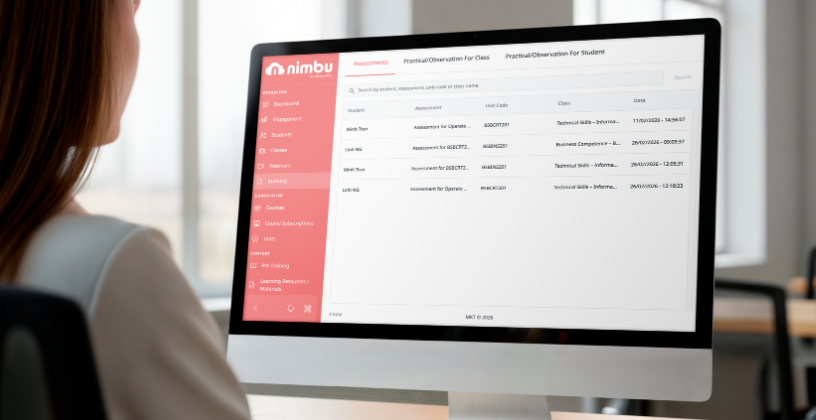
Marking Dashboard: Faster Assessment Workflows Without Spreadsheets
Effective assessment management starts with visibility.
Nimbu’s Marking Dashboard gives trainers a central location to manage submissions, feedback, resubmissions, and student progress. Instead of tracking assessments across emails, spreadsheets, and multiple systems, trainers can immediately see what requires attention. The result is faster turnaround times, clearer workflows, and less administrative effort.
Practical Observations: Capture Evidence Where Training Happens
Practical observations are a critical part of vocational education delivery, but they often create significant administrative overhead.
Nimbu allows trainers to record observations directly within admin workflows, linking evidence to student records and maintaining visibility throughout the assessment process. This reduces duplication while supporting stronger compliance practices.
Learning Progress Summary: Visibility Without Manual Reporting
Monitoring student activity should not require rebuilding reports manually.
Nimbu’s Learning Progress Summary provides visibility into:
- Student progression
- Completion status
- Assessment activity
- Engagement levels
This helps trainers and administrators make informed decisions without spending hours compiling data.
Michi AI Assistant & Michi Tutor Assistant: AI Tools That Reduce Repetitive Work
An AI-assisted LMS should solve practical problems.
Nimbu’s Michi AI Assistant helps content editors by accelerating content creation, simplifying course setup, and reducing repetitive administrative tasks. Rather than replacing people, Michi helps remove the manual work that often slows down training delivery.
On the other hand, Michi Tutor Assistant supports learners by providing instant, AI-powered assistance throughout their training. It answers course-related questions, explains concepts, and helps students find the information they need without waiting for trainer support.
For growing RTOs, this creates meaningful efficiencies without increasing workload.
Learning Journey: Structured Training Delivery Without Complexity
Effective vocational education delivery requires clear progression.
Learning Journey allows RTOs to structure training pathways without technical configuration or complex setup processes. Students gain a clearer learning experience while trainers maintain greater control over delivery sequencing.
Unit Versioning: Maintain Consistency Across Active Delivery
Content updates are necessary, but they should not disrupt active Classes. Unit Versioning allows RTOs to manage content updates while maintaining consistency across existing classes. This helps reduce operational risk while improving content governance.
Cluster Units: Simplify Complex Training Delivery Models
Clustered delivery can become difficult to manage when assessments, units, and evidence are spread across multiple systems.
Nimbu helps centralise these workflows, creating a more structured approach to training delivery.
Self-Served Courses: Scale Delivery Without Scaling Admin
One of the biggest challenges for growing providers is increasing delivery capacity without increasing administration. Self-Served Courses allow students to engage with content independently while reducing manual coordination requirements. This creates a more scalable approach to online training delivery and blended learning environments.
AVETMISS-Ready LMS Integrations for Australian RTOs
An AVETMISS-ready LMS should work with existing systems rather than forcing organisations to rebuild operational processes from scratch.
Nimbu focuses on practical integrations that support real-world RTO workflows.
Quick AVETMISS Exports
Manual reporting processes consume valuable time.
Nimbu simplifies AVETMISS reporting through structured data management and streamlined export functionality. This reduces administrative effort while improving reporting confidence.
Built to Fit Existing RTO Operations
Most providers already have systems and processes in place.
Nimbu is designed to complement existing RTO operations, helping organisations improve workflows without unnecessary disruption.
Understanding RTO LMS Pricing 2026
When evaluating RTO LMS pricing 2026, subscription costs only tell part of the story.
Nimbu offers transparent, affordable pricing with no hidden costs, starting at only $850 per month & ensuring RTOs receive the features they need without paying for unnecessary add-ons. The real question isn’t just how much an LMS costs, it’s whether the platform reduces operational workload or simply shifts that workload elsewhere.
What’s Included in Every Nimbu Plan
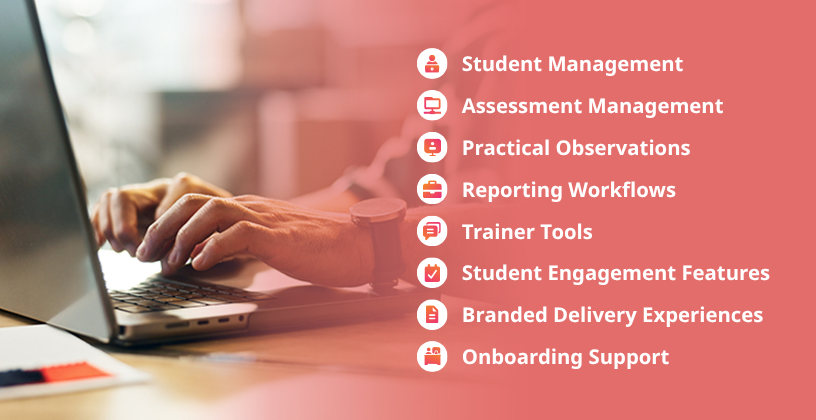
Nimbu plans include core functionality designed to support day-to-day operations, including:
- Student management
- Assessment management
- Practical Observations
- Reporting workflows
- Trainer tools
- Student engagement features
- Branded delivery experiences
- Onboarding support
These are operational necessities, not premium add-ons.
What’s Not Hidden Inside the Pricing
Many providers become frustrated by unexpected costs that appear after implementation.
Nimbu avoids common pricing surprises such as:
- Forced onboarding fees
- Feature-gated reporting
- Hidden support charges
- Upgrade dependencies
This helps organisations budget more effectively and understand the true cost of ownership.
Why Australian RTOs Choose Nimbu
Different organisations use Nimbu for different reasons. Some focus on reducing trainer administration. Others want stronger compliance visibility. Many are looking to improve student engagement, simplify reporting, or support blended delivery environments. The common outcome is workflow clarity.
Instead of relying on disconnected systems and repetitive manual processes, teams gain a structured platform designed specifically for Australian vocational education. As student numbers grow, those efficiencies become increasingly valuable.
Frequently Asked Questions
Whether your goal is reducing administration, improving compliance visibility, increasing student engagement, or supporting growth, Nimbu provides the structure to help you get there.